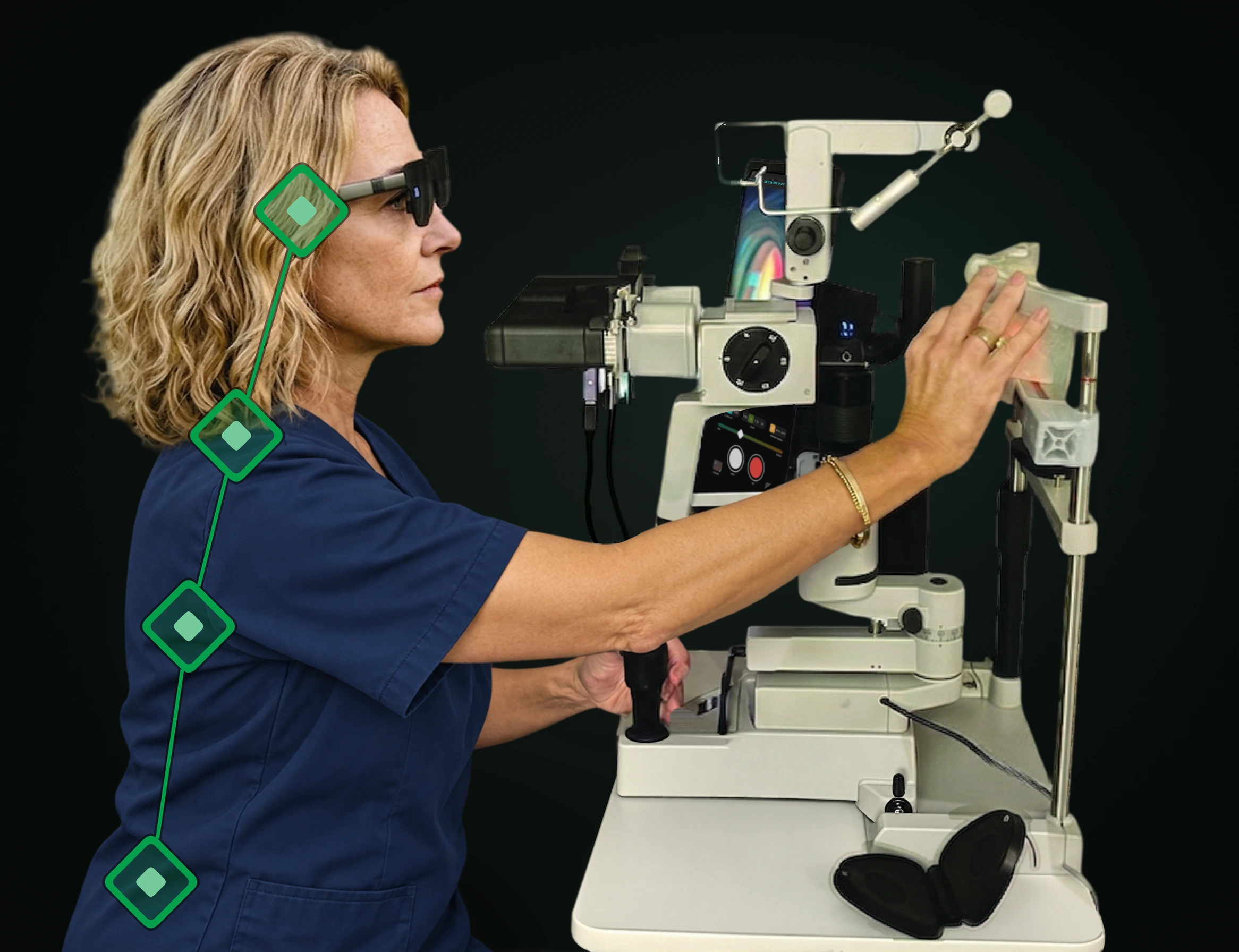
Why is chronic painthe occupational norm in eye care?It’s time to rethink the slit lamp.

Ophthalmologists spend decades craning forward to look through fixed oculars, holding the same uncomfortable position, exam after exam. The research linking that posture to musculoskeletal pain is extensive.

Learn more

The physical demands of eye care.

About

70%

of ophthalmologists report work-related musculoskeletal pain.1

About

Half

of surveyed ophthalmologists with symptoms said slit lamp exams made them worse.2

Up to

44%

of surveyed ophthalmologists modified their workload because of musculoskeletal pain.1

About

1

in

13

surveyed oculoplastic surgeons reported spine surgery, as cited in a 2026 review.3

70% is the pooled figure from 21 studies and 6,691 ophthalmologists.¹ Single studies have found anywhere from 36% to 94%, depending on how they asked about pain.³

More musculoskeletal symptoms in eye care.

In a head-to-head survey at two U.S. institutions, ophthalmologists and optometrists reported neck, hand/wrist and lower-back symptoms more commonly than family-medicine physicians.

Explore ergonomics

2.2×

as commonly reported: neck symptoms⁴

2.4×

as commonly reported: hand/wrist symptoms⁴

2.9×

as commonly reported: lower-back symptoms⁴

Eye care can’t afford to lose its clinicians.

Demand for eye care is projected to grow as the ophthalmology workforce shrinks.

Demand +24% · Supply −12%

Projected change in U.S. ophthalmologist supply and demand, in full-time equivalents, 2020–2035. Historical model.⁵

1 in 7

surveyed ophthalmologists reported early retirement or plans to retire early because of their symptoms.⁶

Care should never cost the caregiver.

More of the ophthalmology workforce is age 55 or older, while demand for eye care continues to grow. Supporting the clinicians already in practice means paying attention to how they work, so they can keep caring for patients.

Age 55 or older

41%51%

of active U.S. ophthalmologists, from 2007 to 2019.7

More than

25%

of active U.S. ophthalmologists were age 65 or older in 2022.⁸

Average retirement age

6568

among OMIC-insured ophthalmologists, from 2000 to 2010.⁹

The patient has to hold position, too.

The chin rest, forehead support and illumination all shape the patient’s experience of a slit lamp exam. Positioning and light deserve attention alongside the clinician’s posture.

VitaPixel SVS is designed around flexible positioning and lower required illumination. With the clinician viewing through our Display Glasses, the slit lamp table can move to where the patient is.

Explore patient comfort
A patient holds position at the slit lamp chin rest and forehead support during an SVS demonstration.

The view shouldn’t end at the eyepieces.

The view through the oculars does not automatically become an image in the patient’s record. Without image capture, the finding has to be described in words or photographed separately.

VitaPixel SVS brings still-image and video capture to the slit lamp. Capture from the live view with a button on the joystick or a tap on the touchscreen.

Explore documentation
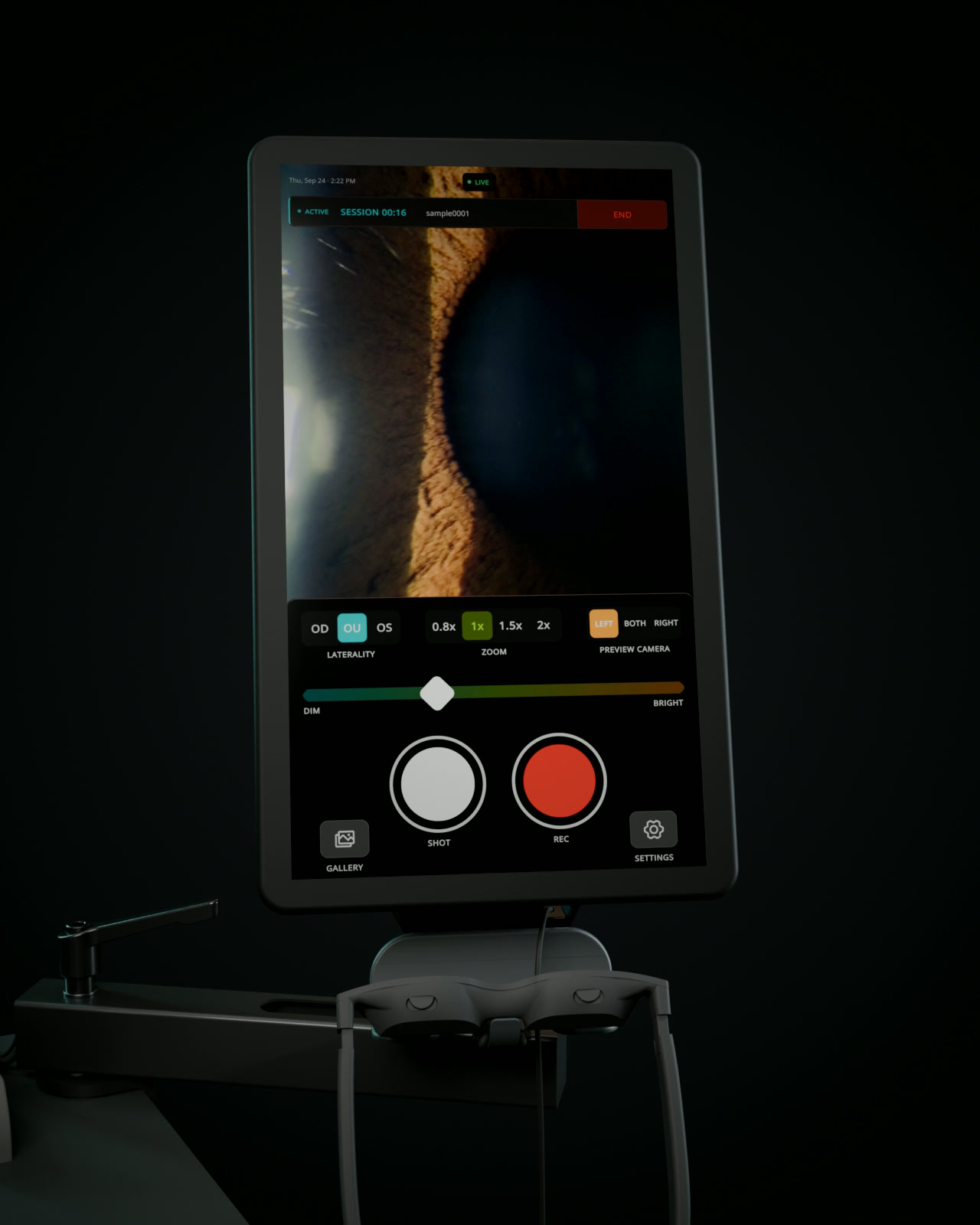
CAD render of the SVS touchscreen terminal showing the recorded capture screen, with our Display Glasses in the cradle below.

Freedom at the slit lamp.

Direct viewing requires you to align with the oculars. VitaPixel SVS brings the stereoscopic view to our Display Glasses, designed to support a natural, upright exam position.
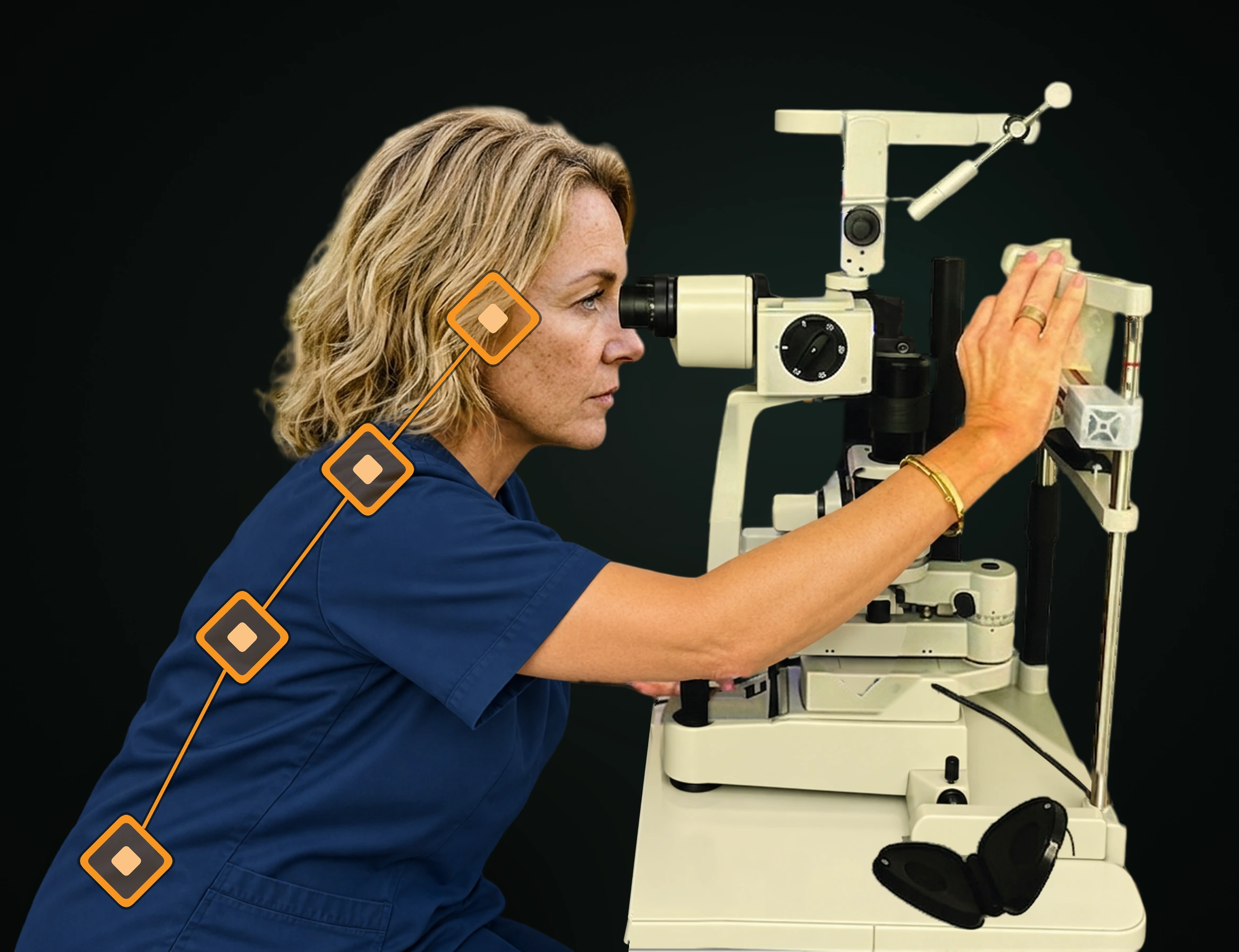
Side view of a clinician leaning in to the slit lamp eyepieces, with posture markers along the neck and back.

At the oculars

Side view of a clinician sitting upright at the slit lamp wearing our Display Glasses, with posture markers along the neck and back.

With our Display Glasses

Research references

Notes

  1. 1.Watt et al., Canadian Journal of Ophthalmology 2026. Pooled estimate from a meta-analysis of 21 studies and 6,691 ophthalmologists.
  2. 2.Robert et al., Journal of Current Ophthalmology 2024. Online survey of Indian ophthalmologists; 209 of 412 respondents with symptoms named slit lamp examination as a task that aggravated their discomfort.
  3. 3.Kaur et al., American Journal of Ophthalmology 2026. Productivity loss and spine surgery are distinct outcomes in the literature reviewed, not a single pooled estimate. “About 1 in 13” is rounded from 7.6% in a survey of oculoplastic surgeons (Sivak-Callcott et al., 2011) cited in the review.
  4. 4.Kitzmann et al., Ophthalmology 2012. Survey at two U.S. institutions: 94 eye-care physicians (ophthalmologists and optometrists) and 92 family-medicine physicians. Ratios are calculated from the reported percentages (neck 46% vs 21%, hand/wrist 17% vs 7%, lower back 26% vs 9%).
  5. 5.Workforce projections: Berkowitz et al., Ophthalmology 2024.
  6. 6.Retirement survey: Schechet et al., Digital Journal of Ophthalmology 2020.
  7. 7.AAMC physician specialty data.
  8. 8.AAMC 2022 workforce data, analyzed by the American College of Surgeons (2024).
  9. 9.OMIC Digest, Fall 2010; retirement ages describe OMIC-insured ophthalmologists, not a national estimate.

Key findings

  • A 2026 meta-analysis of 21 studies involving 6,691 ophthalmologists estimated the prevalence of musculoskeletal pain at 70% (95% confidence interval: 65–75%). Study definitions and results varied substantially. Studies in the review reported workload modification due to pain in up to 44%. Watt et al., Canadian Journal of Ophthalmology 2026. doi
  • A 2026 scoping review reported a weighted average prevalence of work-related musculoskeletal disorders of 62.9% among 3,246 ophthalmologists. The review reports lost work productivity in up to 72%, and spine surgery in 7.6% of respondents to one included survey of oculoplastic surgeons. These figures describe different outcomes in the reviewed literature. Kaur et al., American Journal of Ophthalmology 2026. doi
  • In a survey of Iranian ophthalmologists, 80% of respondents reported back pain. This is an individual survey result, not a pooled estimate for all eye-care professionals. Chams et al., MedGenMed 2004. source
  • In a survey of 94 eye-care physicians (ophthalmologists and optometrists) and 92 family-medicine physicians at two U.S. institutions, lower-back pain was reported by 26% and 9%, respectively. Kitzmann et al., Ophthalmology 2012 (online 2011). doi
  • Among 127 Maryland survey respondents, 85 reported work-related pain. Seventeen reported early retirement or plans to retire early because of their symptoms. Schechet et al., Digital Journal of Ophthalmology 2020. doi
  • A 2024 analysis of the historical 2020 to 2035 HRSA model projected U.S. ophthalmology full-time-equivalent supply down 12% and demand up 24% by 2035, with supply meeting 70% of modeled demand. Berkowitz et al., Ophthalmology 2024. doi
  • Across 64 vitreoretinal surgical cases involving three surgeons, median time upright was 100% with the studied heads-up display and 60% with the standard operating microscope. This was a study of other surgical equipment, not SVS. Moon et al., 2024. doi
  • In a survey of 518 UK consultant-ophthalmologist respondents, 164 reported pain while using the slit lamp. Of those 164, 117 said slit lamp use exacerbated their pain. Hyer et al., International Ophthalmology 2015. doi
  • A prospective, nonrandomized study compared muscle activation and fatigue reports during four surgical sessions by one surgeon using a 3D screen and an operating microscope. Not all measured muscles showed greater activation with the microscope. This study did not evaluate SVS. Hura et al., 2024. doi
  • Among 412 respondents reporting symptoms in an Indian survey of ophthalmologists, residents and fellows, 209 identified slit lamp examination as an activity that aggravated discomfort. There were 551 valid responses overall. Robert et al., published 2024, in an issue dated 2023. doi

Prevalence of musculoskeletal pain in eye care

  • Al-Marwani Al-Juhani M et al. Neck and upper back pain among eye care professionals. Occupational Medicine. 2015;65(9):753–757. doi
  • Aloqab A et al. The relationship between surgical loupes usage, workplace ergonomics, and musculoskeletal disorders among Saudi ophthalmologists. Saudi Journal of Ophthalmology. 2025;39(2):166–173. Published online 2024. Online survey of 93 ophthalmologists and ophthalmology residents from different hospitals in Saudi Arabia. doi
  • Bertelmann T et al. Prevalence of back pain among German ophthalmologists. Ophthalmic Research. 2021;64(6):974–982. doi
  • Chams H et al. Frequency and Assortment of Self-Report Occupational Complaints Among Iranian Ophthalmologists: A Preliminary Survey. MedGenMed. 2004;6(4):1. PMID: 15775828; PMCID: PMC1480566. source
  • Dhimitri KC et al. Symptoms of musculoskeletal disorders in ophthalmologists. American Journal of Ophthalmology. 2005;139(1):179–181. doi
  • Fouzdar Jain S et al. The prevalence of work-related musculoskeletal disease among pediatric ophthalmologists. Clinical Ophthalmology. 2022;16:833–840. doi
  • Kaup S et al. Ergonomic practices and musculoskeletal disorders among ophthalmologists in India: An online appraisal. European Journal of Ophthalmology. 2020;30(1):196–200. Published online 2018. doi
  • Kaur H et al. A Scoping Review of Ergonomics in Ophthalmology: Working in Pain. American Journal of Ophthalmology. 2026;282:433–457. Published online November 14, 2025. doi
  • Kitzmann AS et al. A survey study of musculoskeletal disorders among eye care physicians compared with family medicine physicians. Ophthalmology. 2012;119(2):213–220. Published online 2011. doi
  • Long J et al. Risk factors for physical discomfort in Australian optometrists. Optometry and Vision Science. 2011;88(2):317–326. doi
  • Robert R et al. Digital Survey Assessment of Individual and Occupational Factors Associated with Musculoskeletal Disorders among Indian Ophthalmologists. Journal of Current Ophthalmology. Published 2024;35(3):281–286. Issue dated 2023. doi
  • Schechet SA et al. Survey of musculoskeletal disorders among US ophthalmologists. Digital Journal of Ophthalmology. 2020;26(4):36–45. doi
  • Sivak-Callcott JA et al. A survey study of occupational pain and injury in ophthalmic plastic surgeons. Ophthalmic Plastic and Reconstructive Surgery. 2011;27(1):28–32. Survey of 130 oculoplastic surgeons; source of the 7.6% spine-surgery figure cited by Kaur et al. doi
  • Tan NE et al. Digital Survey Assessment of Factors Associated with Musculoskeletal Complaints Among US Ophthalmologists. Clinical Ophthalmology. 2021;15:4865–4874. doi
  • Wasserman JB et al. Effect of slit lamp table design on neck position and the prevalence of neck pain in eye care professionals. Work. 2022;72(1):181–188. doi
  • Watt H et al. Is ophthalmology a pain-free career? A systematic review and meta-analysis of musculoskeletal pain among ophthalmologists. Canadian Journal of Ophthalmology. 2026;61(5):1132–1143. Published online June 27, 2026. doi

Workforce and demographics

  • Association of American Medical Colleges, Center for Workforce Studies. 2008 Physician Specialty Data. November 2008. Table 4, page 15: 7,376 of 17,846 active U.S. ophthalmologists (41.3%) were age 55 or older in 2007. Association of American Medical Colleges. 2020 Physician Specialty Data Report. January 2021. Table 1.4: 51.1% of active U.S. ophthalmologists were age 55 or older in 2019. Displayed figures are rounded to 41% and 51%; they describe the share age 55 or older, not average age.
  • Berkowitz ST et al. Ophthalmology workforce projections in the United States, 2020 to 2035. Ophthalmology. 2024;131(2):133–139. Published online 2023. Historical model analysis. doi
  • Newman MS. Physician Workforce Data Suggest Epochal Change. American College of Surgeons Bulletin. April 10, 2024. Analysis of AAMC workforce data as of December 31, 2022. source
  • Ophthalmic Mutual Insurance Company. Ophthalmologists Working Longer, Retiring Later. Ophthalmic Risk Management Digest. Fall 2010;20(4):2. Average retirement age of OMIC insureds: 65 in 2000 and 68 in 2010. source

Studies of equipment and ergonomic interventions

  • Akler ME et al. Pilot study of musculoskeletal pain in ophthalmologists following participation in a fifteen-minute online Iyengar yoga program. Digital Journal of Ophthalmology. 2024;30(1):5–10. doi
  • Moon JY et al. Comparison of Ergonomics in Vitreoretinal Surgery With Heads-up Visualization Versus the Standard Operating Microscope as Measured by a Wearable Device. Ophthalmic Surgery, Lasers and Imaging Retina. 2024;55(11):638–645. doi
  • Schall MC Jr et al. A comparison of examination equipment used during common clinical ophthalmologic tasks. IIE Transactions on Occupational Ergonomics and Human Factors. 2014;2(2):105–117. doi
  • Vaiano AS et al. Use of 3D visualization system in deep sclerectomy: preliminary results from a pilot study. BMC Ophthalmology. 2025;25:573. doi
  • Xie JS et al. A Scoping Review of Ergonomics in Ophthalmology: Working Smarter. American Journal of Ophthalmology. 2026;281:249–269. Published online August 30, 2025. doi

Further research in eye care

  • Huang Z et al. Comparison of Digital Camera Real-Time Display with Conventional Teaching Tube for Slit Lamp Microscopy Teaching. Current Eye Research. 2022;47(1):161–164. Published online 2021. doi
  • Hura AS et al. Intraoperative Electromyogram Analysis of Postural Musculature With Three-dimensional Screen Display Versus Operating Microscope in Ophthalmic Surgery: A Clinical Methods Study. Ophthalmic Surgery, Lasers and Imaging Retina. 2024;55(11):628–636. doi
  • Hyer JN et al. National survey of back & neck pain amongst consultant ophthalmologists in the United Kingdom. International Ophthalmology. 2015;35(6):769–775. doi
  • Wenting SZ et al. A comparison of undergraduate clinical ophthalmology learning methods: smart phone television display versus slit-lamp teaching telescope. Canadian Journal of Ophthalmology. 2017;52(4):385–391. doi

The 70% headline is a pooled estimate from Watt’s 2026 meta-analysis. For chronic pain specifically, 66% of 101 surveyed pediatric ophthalmologists reported chronic pain (Fouzdar Jain et al., 2022). Kaur’s 2026 scoping review reports a range of 35.9–93.8% (rounded to 36–94%) across studies, reflecting differences between studies rather than a pooled estimate. The surgery figure is rounded from 7.6% in an oculoplastic-surgeon survey (Sivak-Callcott et al., 2011) included in the review. These studies describe ophthalmologists’ working conditions and symptoms. They do not evaluate VitaPixel SVS.

Explore the VitaPixel SVS.

Learn how the SVS is designed around the slit lamp exam, then share how you work with the team.

Reserve yours